


On this page
Viome and GI-MAP® both start with a stool sample, but they are built for different jobs. Viome's Gut Intelligence™ Test is a consumer wellness test that sequences microbial RNA to estimate what gut microbes are doing, then turns the results into food recommendations. GI-MAP is a practitioner-ordered stool panel: it uses quantitative PCR (qPCR) to look for specific pathogens, parasites, H. pylori and other organisms, and it also reports markers of digestion and inflammation, so it belongs in a clinical workup rather than a self-directed wellness check.
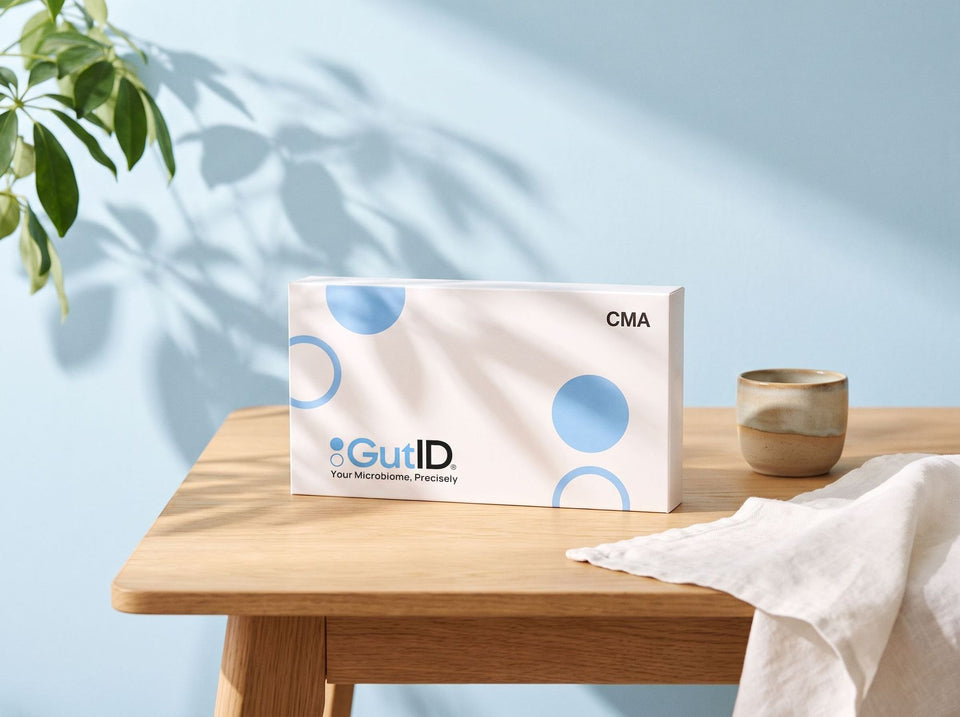
GutID takes a third route. Rather than checking a preset list, its Titan-1™ long-read sequencing follows about 2,500 bases of ribosomal DNA per bacterium in one continuous read and maps the entire bacterial ecosystem, species by species; more than 30 peer-reviewed publications have used the same long-read approach. Through a clinician, GutID Pro adds 65 targeted markers, including enteric viruses, parasites, Candida, calprotectin and H. pylori stool antigen, to the same kit.
This comparison is for consumers wondering whether Viome can stand in for GI-MAP, or the reverse. It also takes a short look at Vibrant Wellness's Gut Zoomer, another practitioner-ordered panel.
Viome vs. GI-MAP at a glance
| Attribute | Viome Gut Intelligence™ Test | GI-MAP® | GutID |
|---|---|---|---|
| Who orders it | You, directly from Viome | A healthcare practitioner | You, online; GutID Pro requires an approved clinician's order |
| Method | Metatranscriptomic sequencing of microbial RNA | Quantitative PCR, one assay per target organism, with ELISA used for several gut-function markers | Titan-1™ long-read ribosomal sequencing of one continuous ~2,500-base region; Pro adds lab panels |
| What it measures | Which microbial functions are active (Viome cites 400+ pathways); results come as 25+ scores and 370+ food recommendations | Bacterial, parasitic and viral pathogens; H. pylori and virulence factors; commensal, overgrowth and opportunistic microbes; fungi; protozoa and worms; digestion, immune and inflammation markers; H. pylori antibiotic resistance genes | Every bacterium in the sample to species level, with diversity, balance and relative abundance; Pro adds 65 markers, from enteric viruses, parasites and Candida to calprotectin |
| Sample | Pea-sized stool sample in a preservative tube | One stool specimen in DSL's vial, mailed at ambient temperature | Stool collected at home; Pro uses a second tube from the same collection |
| Results | About 2–3 weeks | 7–10 business days (DSL's posted turnaround at time of writing) | Roughly 3–4 weeks after the sample reaches the lab |
| Price (at time of writing) | $279 for one test, or $229 per test on a 180-day subscription | Not listed on DSL's test page | Core Gut Insights $399; Complete Microbiome Assessment $599 |
| Insurance | Not billed to insurance; HSA/FSA eligible through Truemed | DSL files claims to insurance and Medicare | HSA/FSA eligible in the US |
| Availability | Free US shipping | Cannot be ordered in New York State | Free shipping both ways; Pro: US except New York State, adults 18+ |
| How the company describes it | Educational; "not intended to be used by the customer for any diagnostic purpose" | "A diagnostic tool" | Wellness and educational insights; approved clinicians order and interpret Pro |
| Best suited to | Adults exploring diet and microbial activity on their own | People working with a clinician on digestive symptoms who need targeted organism and gut-function testing | Seeing the entire bacterial ecosystem; with a clinician, Pro adds targeted markers |
How Viome's gut test works
Every microbe in your gut carries genes, but only some of them are in use at a given moment. When a gene is in use, the cell copies it into messenger RNA. Viome sequences that RNA from the stool sample, a method called metatranscriptomics, to infer which functions the microbial community is carrying out. Viome says its CLIA-certified lab analyzes this activity across 400+ biological pathways and condenses it into 25+ gut health scores.
The process is designed for home use. You scoop a pea-sized amount of stool into a tube of preservative and mail it in, and Viome's sample guide says results typically arrive in about two to three weeks. The output is nutrition-focused: 370+ personalized food recommendations, with personalized supplements and a gut formula available separately by subscription. At time of writing (October 2026), the test costs $279 on its own or $229 every 180 days on a subscription built around retesting every six months. Viome describes its information as educational and not intended for diagnostic use. If you are weighing Viome against another consumer kit, see Tiny Health vs. Viome.
How GI-MAP works
GI-MAP® (GI Microbial Assay Plus) comes from Diagnostic Solutions Laboratory (DSL). Instead of sequencing whatever is in the sample, it runs quantitative PCR assays, each aimed at the DNA of one organism, across a menu that DSL says covers parasites, bacteria, H. pylori, fungi and more. Because every assay has a defined target and returns an amount, the report reads as a list of named organisms with measured values. DSL calls GI-MAP a diagnostic tool.
On DSL's sample report, organisms are sorted into pathogens (bacterial, parasitic and viral), H. pylori with its virulence factors, commensal and keystone bacteria, dysbiotic and overgrowth bacteria, inflammation-associated bacteria, fungi and yeast, protozoa and worms. Beyond microbes, a gut-function block covers digestion (steatocrit and elastase-1), immune activity (secretory IgA, anti-gliadin IgA and eosinophil activation protein) and inflammation (calprotectin), plus β-glucuronidase and an occult blood (FIT) result. Zonulin and a fecal gluten peptide test can be added. Each of those sections is explained in what a GI-MAP tests for.
The ordering rules are clinical. DSL states that a healthcare practitioner must order the test, that GI-MAP is not available for ordering in New York State, and that it files claims to insurance and Medicare. The kit uses a single stool sample shipped at room temperature, and DSL's posted turnaround at time of writing is 7–10 business days.
Key differences
Open-ended activity vs. a defined panel
Viome sequences RNA from the sample rather than testing for a preset list of organisms, then infers what the community is doing. GI-MAP checks a defined list of targets and quantifies each one. The two reports look very different as a result: Viome's is a set of scores and food lists, while GI-MAP's is a table of named organisms and markers with values.
Self-directed vs. clinician-led
Viome is designed for you to buy and act on yourself, through diet and optional supplements. GI-MAP can only be ordered by a practitioner, so a clinician is involved from the start and can read the results against your history and symptoms.
How you pay
Viome is cash-pay and HSA/FSA eligible through Truemed, with a single-test price and a six-month subscription. DSL does not post a GI-MAP price on its test page; it files insurance and Medicare claims, so what you pay depends on your coverage. Our GI-MAP cost guide looks at this in more detail.
The questions each can answer
Want to know whether a particular pathogen, parasite or H. pylori is there? That is the job GI-MAP was designed to do. If you want to know how your microbial community responds to your diet, including blood-sugar response, Viome's activity scores are aimed at that. Viome does not present its test as a pathogen screen.
Gut Zoomer vs. Viome
Vibrant Wellness's Gut Zoomer sits much closer to GI-MAP than to Viome. Vibrant's test page says it requires a clinician's order and describes the panel as integrating microbiome balance, pathogens, inflammation, digestion, permeability and detox metabolites, listing 75+ gut pathogens and more than 100 commensal bacteria. In its July 2025 redesign announcement, Vibrant said the panel combines PCR, sandwich ELISA, LC-MS/MS and protein microarray technologies, and the current test page also lists timed urine samples for neurotransmitter markers.
Vibrant does not accept insurance for the Gut Zoomer but lists it as HSA/FSA eligible. The standard version is not available in New York, where Vibrant offers a separate Gut Zoomer - New York panel. For the two practitioner panels side by side, see GI-MAP vs. Gut Zoomer.
When Viome is the right choice
- You are an adult without red-flag symptoms who wants to explore how diet and microbial activity connect.
- You want to order without a clinician and get food recommendations you can act on yourself.
- You like the idea of repeating the test twice a year to watch your scores move.
When GI-MAP is the right choice
- You have ongoing digestive symptoms and your practitioner wants to check for specific pathogens, parasites or H. pylori.
- You want gut-function markers such as elastase-1, calprotectin and secretory IgA reported alongside microbial results.
- You would prefer a lab that bills insurance or Medicare directly; DSL files those claims.
When GutID is the better choice
- You want the whole bacterial ecosystem (every species, in what proportion, and how it shifts between tests) rather than a preset list, ordered without a clinician.
- You want organisms a fixed panel can't identify to show up too, even bacteria that have no species name yet.
- You work with a clinician and want the ecosystem and targeted markers from one collection; GutID Pro includes both.
If you might have an acute infection, or notice blood in the stool, unexplained weight loss, fever, or severe or persistent diarrhea, see a clinician for diagnostic testing before starting with any home kit.
Why GutID sees more
GI-MAP's qPCR assays each target an organism chosen in advance, so a bacterium that isn't on the list can't appear in the results. Viome's report, as Viome describes it, condenses microbial activity into scores and food recommendations. GutID starts from the whole bacterial ecosystem instead: Titan-1 resolves every bacterium in the sample to species and measures it, organisms that are novel or uncharacterized included, and the report shows the community's diversity and balance and how they change over time.
That rests on the read. Each Titan-1 read runs about 2,500 bases without a break, across a patented amplicon covering the whole 16S gene, the ITS and the beginning of 23S: 5–10 times longer than the roughly 250 to 460 bases a typical short-read 16S test reads. GutID's classifier draws on the entire read instead of comparing short markers with a fixed database, giving species-level identification with relative abundance from strain-level data. Behind it sit 30+ peer-reviewed publications using the long-read approach, in journals such as PLOS ONE, ISME Communications and mBio; see GutID's science page and the evidence behind Titan-1.
For anyone working with a clinician, GutID Pro combines the ecosystem with 65 targeted markers in one kit, adding enteric bacteria and viruses, parasites, Candida, calprotectin and pancreatic elastase-1 from the same collection. Read about GutID Pro, then ask your clinician; approved clinicians order it for patients 18 and over in any US state except New York. The GutID sample report and GutID vs. GI-MAP show more.
Frequently asked questions
Is Viome the same as a GI-MAP test?
No. Viome is a direct-to-consumer RNA test that estimates microbial activity and produces food recommendations. GI-MAP is a practitioner-ordered qPCR panel, described by DSL as a diagnostic tool, that tests for specific organisms and measures intestinal health markers. One does not replace the other.
Is GutID better than Viome or GI-MAP?
Yes, if your goal is to see the entire bacterial ecosystem. A GI-MAP report covers a fixed panel of chosen targets and Viome's centers on activity scores, while GutID reads every bacterium in the sample from a continuous ~2,500-base read, identifies organisms a fixed panel can't and reports each species' relative abundance across the whole community. Its long-read method is backed by 30+ peer-reviewed publications. If you also need targeted markers, GutID Pro adds them to the same kit through your clinician.
Can I order GI-MAP myself the way I order Viome?
DSL states that a healthcare practitioner must order GI-MAP, and the test is not available for ordering in New York State. Viome, by contrast, sells its Gut Intelligence Test directly to consumers.
Does the Viome gut test check for parasites or H. pylori?
Viome presents the Gut Intelligence Test as a measure of microbial activity, not as a screen for pathogens or parasites, and says its results are not for diagnostic purposes. GI-MAP includes targeted assays for parasites, worms and H. pylori with virulence factors. If you are worried about an infection, talk to your clinician.
What does GutID Pro add?
Pro keeps the full Complete Microbiome Assessment and adds 65 markers, processed by a CLIA laboratory from a second tube filled during the same collection. The GI panel covers twelve enteric bacteria, Salmonella and Campylobacter among them, plus six each of enteric viruses, parasites and Candida species. Pro also measures calprotectin, pancreatic elastase-1 and fecal occult blood, tests for H. pylori stool antigen and reports 31 commensal and dysbiotic bacterial markers. Everything comes back on one report in 3–4 weeks. Consumers can't buy Pro directly; ask your clinician.
Gut Zoomer vs. Viome: which is which?
Gut Zoomer is Vibrant Wellness's clinician-ordered panel, which pairs microbial testing with inflammation, digestion, permeability and metabolite markers. Viome is a consumer RNA test centered on microbial activity and nutrition. Neither is billed to insurance, and both are listed as HSA/FSA eligible by their makers.
Sources
- GI-MAP® — Diagnostic Solutions Laboratory (accessed October 30, 2026)
- GI-MAP Sample Report — Diagnostic Solutions Laboratory (accessed October 30, 2026)
- Gut Intelligence™ Test — Viome (accessed October 30, 2026)
- 6 Things to Know Before Collecting Samples for Your Viome Intelligence Test — Viome (accessed October 30, 2026)
- Gut Zoomer — Vibrant Wellness (accessed October 30, 2026)
- Vibrant Wellness Launches Redesigned Gut Microbiome Test With Broader Microbial and Metabolic Insights — Newswire (accessed October 30, 2026)
GutID provides wellness and educational insights and is not a diagnostic test. GI-MAP, Viome, Gut Intelligence, Gut Zoomer and Tiny Health are trademarks of their respective owners. GutID is not affiliated with Diagnostic Solutions Laboratory, Viome Life Sciences, Vibrant Wellness or Tiny Health.
See your own
Core $399 · Complete $599
Free shipping both ways. HSA/FSA eligible in the US.
This article is for education and is not medical advice. GutID provides wellness and educational insights and is not a diagnostic test.
