
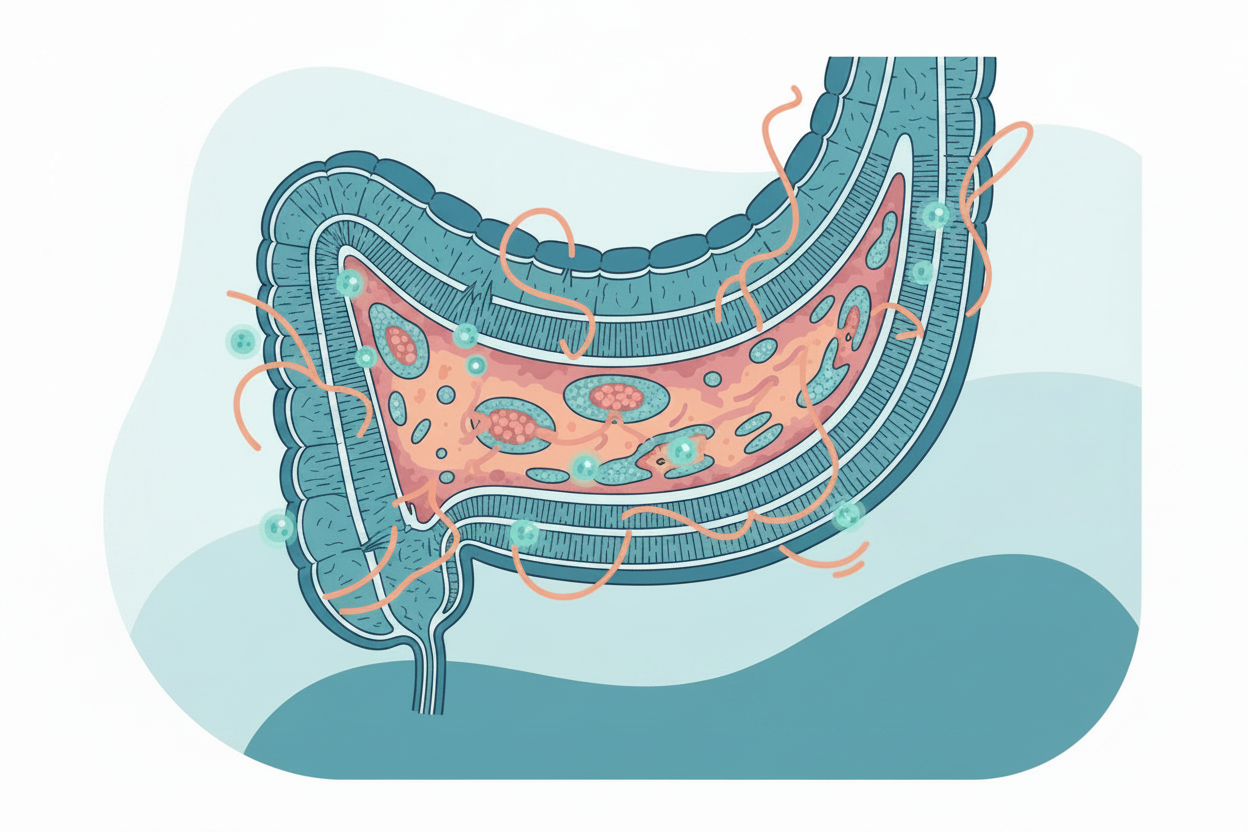

Fecal calprotectin has become one of the most used biomarkers for assessing intestinal inflammation. It is non-invasive, relatively inexpensive, and can provide valuable information when someone presents with symptoms such as chronic diarrhea, abdominal pain, changes in bowel habits, or bloating.
But like any biomarker, fecal calprotectin answers a specific clinical question.
A high result does not tell you exactly why inflammation is occurring. A normal result does not mean that everything in the gastrointestinal tract—or the microbiome—is healthy.
Understanding that distinction can help clinicians use calprotectin appropriately and recognize when additional information about the gut ecosystem may be useful.
What Is Fecal Calprotectin?
Calprotectin is a protein found primarily in neutrophils, a type of white blood cell involved in the inflammatory response.
When inflammation occurs in the intestinal mucosa, neutrophils migrate into the intestinal lumen and calprotectin concentrations in the stool increase. This makes fecal calprotectin a useful non-invasive marker of intestinal inflammation.
This is an important distinction:
Fecal calprotectin measures inflammation. It does not measure the microbiome itself.
What Does Fecal Calprotectin Tell You?
One of its best-established clinical uses is helping clinicians differentiate between inflammatory and non-inflammatory gastrointestinal presentations.
For example, symptoms of irritable bowel syndrome (IBS) and inflammatory bowel disease (IBD) can overlap significantly. Both may involve abdominal pain, diarrhea, changes in bowel habits, and bloating.
But their underlying biology is very different.
IBD—including Crohn's disease and ulcerative colitis—involves intestinal inflammation, while IBS is not defined by overt intestinal inflammation.
NICE therefore recommends fecal calprotectin as an option to help differentiate IBD from IBS in appropriate patients with recent-onset lower gastrointestinal symptoms when cancer is not suspected.
In evidence reviewed by NICE, fecal calprotectin performed well in this setting. At a commonly used threshold of 50 µg/g, a meta-analysis of five studies in secondary-care adults found a sensitivity of 93% and specificity of 94% for distinguishing IBD from IBS.
That makes calprotectin particularly valuable as a screening and triage tool.
Fecal Calprotectin Can Also Help Monitor IBD
Calprotectin isn't only useful when investigating new symptoms.
In people with established IBD, it can provide information about inflammatory disease activity and can correlate with endoscopic inflammation.
The 2025 British Society of Gastroenterology guidelines recommend using fecal calprotectin to monitor patients with known Crohn's disease when a baseline value is available. Importantly, the guidelines note that changes within an individual over time may be more meaningful than relying on a single absolute number.
This makes longitudinal testing particularly useful.
A rising result may suggest increasing inflammatory activity, while a falling result can provide evidence that inflammation is improving.
But this brings us to an important limitation.
An Elevated Calprotectin Does Not Diagnose IBD
Fecal calprotectin tells you:
There may be intestinal inflammation.
It does not tell you:
This patient has Crohn's disease.
Elevated calprotectin can occur in conditions other than IBD. For example, intestinal infections and some colorectal neoplasms can also increase fecal calprotectin.
That means an elevated result should be interpreted alongside the patient's:
- Symptoms and clinical history
- Age and risk factors
- Medications
- Other laboratory findings
- Infectious work-up when appropriate
- Endoscopic or imaging findings when indicated
The number is a clue—not a diagnosis.
What Does a Normal Fecal Calprotectin Tell You?
This distinction is equally important.
A low fecal calprotectin can provide reassurance that significant intestinal inflammation is less likely in an appropriate clinical context. Its high negative predictive value is one reason the test is so useful when clinicians are deciding whether symptoms are more consistent with IBD or a non-inflammatory condition such as IBS.
But:
Normal calprotectin does not mean a normal gut.
A patient can have significant digestive symptoms with normal calprotectin.
They may still experience:
- Bloating
- Constipation
- Diarrhea
- Food-related symptoms
- Altered fermentation
- Changes in microbial community structure
- Reduced microbial diversity or resilience
- Overdominance of particular microbial groups
Fecal calprotectin was never designed to answer those questions.
Calprotectin vs. Microbiome Testing: Different Questions
This is where understanding the purpose of different stool measurements becomes important.
Think of fecal calprotectin as an inflammation marker.
It answers:
Is there evidence of intestinal inflammatory activity?
Microbiome testing asks a different set of questions:
What does the microbial ecosystem look like?
Which organisms make up that ecosystem and in what relative proportions?
How diverse, balanced, and resilient is the microbial community?
Which bacterial patterns are associated with or contributing to potential inflammation?
These measurements should not be treated as interchangeable.
Where the Microbiome Fits In
The relationship between inflammation and the microbiome is complex and bidirectional.
Host immune activity can alter the intestinal environment and change which microbial populations are able to thrive. At the same time, microbial metabolites and interactions with the intestinal barrier and immune system can influence the local environment.
That means an elevated calprotectin and an altered microbiome may coexist—but one result should not automatically be assumed to explain the other.
This is particularly important clinically.
Finding an altered microbial pattern in someone with elevated calprotectin does not prove that those bacteria caused the inflammation.
Likewise, reducing a particular bacterium does not necessarily mean the underlying inflammatory process has resolved.
Calprotectin and microbiome data provide different layers of information.
Why GutID Looks at the Ecosystem
GutID® is not a replacement for fecal calprotectin.
Instead, GutID is designed to answer questions that an inflammatory marker cannot.
Using patented Titan-1™ long-read sequencing technology, GutID characterizes the bacterial ecosystem and allows clinicians to evaluate patterns including:
- Relative abundance
- Diversity and evenness
- Ecosystem resilience
- Dominant bacterial populations
- Potential ecosystem disruptors
- Functional potential
- FODMAP sensitivity and fermentation patterns
- Beneficial organisms within the context of the broader ecosystem
This allows clinicians to move beyond a single measurement and begin asking:
What patterns are present within this patient's bacterial ecosystem?
For someone with digestive symptoms but normal calprotectin, microbiome assessment may provide a different lens through which to investigate their presentation.
For someone with elevated calprotectin, microbiome data may provide additional ecological context—but the elevated inflammatory marker itself still warrants appropriate medical evaluation.
One Biomarker Shouldn't Tell the Whole Gut Story
Perhaps the most important lesson from fecal calprotectin is also one of the most important principles in gut health:
Different measurements answer different questions.
Calprotectin can tell us whether intestinal inflammation may be present.
It cannot tell us why.
It cannot characterize microbial diversity.
It cannot tell us whether one bacterial group dominates the ecosystem.
And it cannot provide a complete picture of gut health by itself.
Similarly, microbiome testing cannot replace established inflammatory biomarkers, endoscopy, imaging, or appropriate medical evaluation when inflammatory disease is suspected.
The goal is not to make one test do everything.
It's to understand what each measurement tells us—and then integrate those pieces into the broader clinical picture.
The Bottom Line
Fecal calprotectin is a valuable, evidence-supported marker of intestinal inflammation. It is particularly useful for helping distinguish inflammatory conditions such as IBD from non-inflammatory presentations such as IBS and for monitoring inflammatory activity in established IBD.
But it is not a comprehensive assessment of gut health.
Calprotectin tells you about inflammation. Microbiome testing tells you about the microbial ecosystem.
Understanding the difference helps clinicians choose the right measurement for the clinical question—and avoid asking a single biomarker to tell a story it was never designed to tell.
Frequently Asked Questions
What does a high fecal calprotectin mean?
It indicates increased intestinal inflammatory activity, but it does not identify the cause. IBD is one possibility, but infection and other gastrointestinal conditions can also elevate calprotectin. An elevated result should be interpreted in clinical context and may warrant additional investigation.
Does high calprotectin mean I have IBD?
No. Fecal calprotectin can support the investigation of suspected IBD, but it does not diagnose Crohn's disease or ulcerative colitis by itself. Diagnosis requires integration with clinical evaluation and, when appropriate, endoscopy, histology, imaging, and other investigations.
Does normal calprotectin mean my gut is healthy?
No. A low result makes significant intestinal inflammation less likely in the appropriate setting, but it does not assess digestion, microbial composition, diversity, fermentation, or every possible cause of gastrointestinal symptoms.
Can a microbiome test measure inflammation?
A microbiome test and an inflammatory biomarker provide different information. Microbiome composition may be associated with inflammatory states, but microbial patterns should not be treated as a direct measurement of inflammation. Fecal calprotectin directly provides evidence about intestinal inflammatory activity.
Should calprotectin and microbiome testing be used together?
They may provide complementary information when clinically appropriate. Calprotectin can help answer whether intestinal inflammation is present, while microbiome testing can characterize the bacterial ecosystem. Which tests are appropriate depends on the patient's presentation and clinical question.
Share:
Can Gut Microbiome Testing Help Cancer Patients Reduce Their Risk of Recurrence?
GutID vs. Genova GI Effects: Which Gut Test Is Right for Your Patients?