
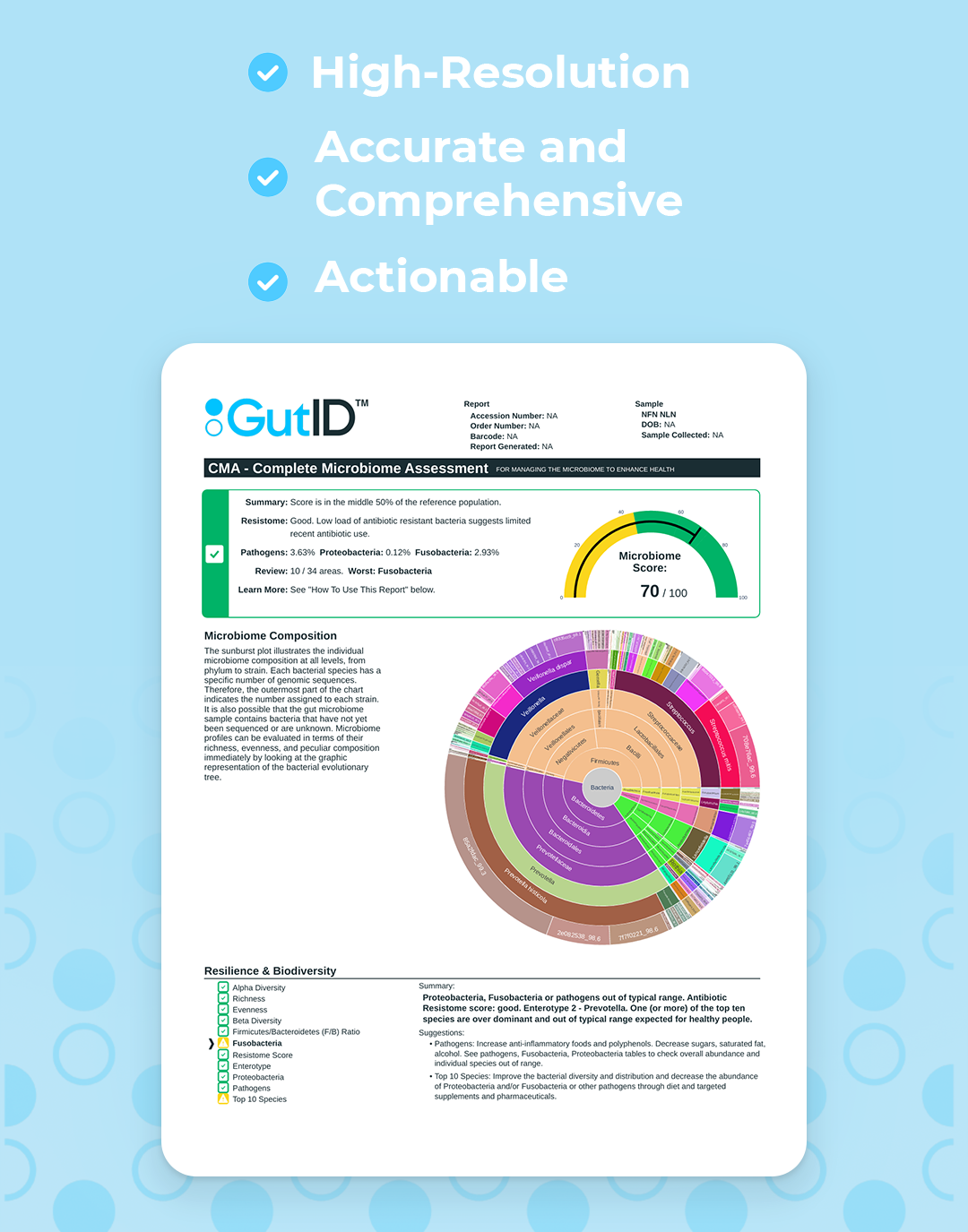

A GutID microbiome report includes several key sections: a microbiome health score (0 to 100) summarizing your overall gut health, a detailed bacterial composition at the strain level, microbiome diversity metrics (richness, evenness, resilience), beneficial bacteria and pathogen profiles, inflammation risk markers, condition-associated biomarkers (IBS, SIBO, IBD indicators), antibiotic resistance gene profiles (resistome), gut barrier function status, and personalized food, supplement, and lifestyle recommendations. The CMA test additionally includes Gut Axes analysis connecting your microbiome to brain, heart, immune, and metabolic health. Each section is designed to be actionable, not just informational, so you and your clinician can take targeted steps based on your unique results.
TLDR:
-
Your GutID report starts with a microbiome health score (0-100) that gives you an at-a-glance summary of your overall gut health status.
-
The bacterial composition section lists strains identified in your sample that can be categorized as beneficial, potentially harmful, or neutral.
-
Diversity metrics (richness, evenness, resilience) tell you how robust and balanced your microbial community is.
-
Flagged areas highlight specific concerns: elevated pathogens, depleted beneficial bacteria, inflammation markers, barrier dysfunction, or SIBO indicators.
-
Personalized recommendations provide specific food, supplement, and lifestyle guidance based on your individual results, plus drug and nutrient interaction tables for clinician use.
How to Read Your GutID Microbiome Report: A Patient Guide
You took the test, mailed your sample, and now your GutID report has arrived. It is packed with data, and that is exactly the point. GutID provides the most detailed, strain-level microbiome analysis available to consumers. But all that precision is only useful if you understand what you are looking at.
This guide walks you through every section of your GutID report, explains what the numbers and categories mean, and shows you how to turn your results into action. It applies to both the CGI (Core Gut Insights) and CMA (Complete Microbiome Assessment) reports, with notes on the additional sections included in the CMA.
Whether you are a first-time tester, a returning patient tracking progress, or a clinician interpreting results for a patient, this guide has you covered.
What Does a GutID Report Include?
Your GutID report includes the following main sections:
-
Microbiome Health Score (0-100)
-
Bacterial Composition at the Strain Level
-
Microbiome Diversity Metrics (richness, evenness, resilience)
-
Beneficial Bacteria Profiles
-
Pathogen Profiles and Flagged Areas
-
Inflammation Risk Assessment
-
Condition Biomarkers (IBS, SIBO, IBD indicators)
-
Antibiotic Resistance Gene Profile (resistome)
-
Gut Barrier and Mucosa Function
-
Personalized Recommendations (food, supplement, lifestyle)
-
Drug, Supplement, Food, and Nutrient Interaction Tables
-
Gut Axes Analysis (CMA only: gut-brain, gut-heart, gut-immune, gut-metabolism)
Let's walk through each one.
Section 1: Your Microbiome Health Score (0-100)
This is usually the first thing you see. Your microbiome health score is a single number between 0 and 100 that summarizes the overall status of your gut microbiome. It is calculated from multiple factors, including diversity, beneficial bacteria levels, pathogen presence, inflammation indicators, and barrier function.
How to interpret it:
A higher score generally reflects a more balanced, diverse, and healthy microbiome. A lower score indicates areas that need attention. Think of it like a credit score for your gut: it gives you a snapshot, but the real value is in understanding what is driving that number.
Do not panic if your score is not perfect. Very few people have a "perfect" microbiome. The score is designed to be a starting point for understanding where you are and tracking improvement over time.
Research from Mayo Clinic on developing computational tools to measure gut microbiome wellness demonstrated that AI-based health indices can detect subtle changes in gut health, identifying whether a person may be progressing toward or recovering from a condition. GutID's AI-powered scoring system follows a similar principle, translating complex bacterial data into a clear, actionable metric.
Section 2: Bacterial Composition at the Strain Level
This is the heart of your report and where GutID's Titan-1 technology truly differentiates itself. Your bacterial composition section lists every organism identified in your sample, with strain-level precision.
What you will see:
Each bacterium is listed with its full taxonomic classification (phylum, class, order, family, genus, species, and strain where available) and its relative abundance, expressed as a percentage of your total microbial community.
Organisms are typically categorized as:
-
Beneficial: Bacteria associated with positive health outcomes (e.g., Faecalibacterium prausnitzii, Akkermansia muciniphila, Bifidobacterium and Lactobacillus species)
-
Potentially harmful: Bacteria that may contribute to symptoms or health risks when present at elevated levels (e.g., certain Enterobacteriaceae, Klebsiella, toxin-producing strains)
-
Neutral/variable: Bacteria whose health effects depend on context, abundance, or the specific strain present
Why strain-level matters here:
A review in Genome Medicine established that even closely related bacterial strains can have extensive genetic and functional differences. Your report shows you the specific strain, not just the species, to more deeply understand your microbiome. This is a level of detail that most other tests cannot provide.
Section 3: Microbiome Diversity Metrics
Your diversity section includes several interrelated metrics:
Richness measures how many different species are present in your sample. A higher number generally indicates a healthier microbiome.
Evenness measures how equally distributed those species are. A gut where one species dominates and all others are present in tiny amounts is less "even" than one where many species share the space more equally.
Resilience reflects your microbiome's ability to recover from disruptions (like antibiotic use, illness, or dietary changes). A resilient microbiome bounces back; a fragile one may shift toward dysbiosis.
How to interpret them:
Research published in Gut (BMJ) has consistently linked higher microbiome diversity to better health outcomes, while low diversity is associated with conditions including inflammatory bowel disease, metabolic syndrome, and mood disorders. If your diversity scores are lower than optimal, your personalized recommendations will include specific strategies to improve them.
Section 4: Beneficial Bacteria Profiles
This section highlights the bacteria in your gut that are associated with positive health outcomes. Key organisms your report may feature include:
-
Faecalibacterium prausnitzii: The most important butyrate producer in the human gut. Butyrate feeds colon cells and supports anti-inflammatory processes. Low levels are a common finding in IBS, IBD, and metabolic conditions.
-
Akkermansia muciniphila: Supports the gut's protective mucus layer and is associated with metabolic health. Declining levels have been linked to obesity and metabolic syndrome.
-
Bifidobacterium species and strains: Important for immune function, digestion, and (in infants) healthy gut development.
-
Lactobacillus species and strains: Well-studied probiotic bacteria involved in immune support, GABA production, and digestive comfort.
-
Other SCFA producers: Including Roseburia and Eubacterium rectale, which contribute to butyrate and propionate production.
Your report shows the relative abundance of each beneficial organism and whether it falls within a healthy range. If key beneficial bacteria are depleted, this is flagged and addressed in your personalized recommendations.
Section 5: Pathogen Profiles and Flagged Areas
This section identifies potentially harmful organisms and flags areas of concern. It may include:
-
Elevated pathogens: Bacteria present at levels that may contribute to symptoms or health risks
-
Known toxin producers: Species with genetic potential to produce harmful compounds
-
Opportunistic organisms: Bacteria that may be harmless at low levels but problematic when overrepresented
Flagged areas are designed to draw your attention to the findings that matter most. They are not diagnoses; they are data points that, combined with your symptoms and clinical context, help you and your healthcare provider make informed decisions.
Section 6: Inflammation Risk Assessment
Your report assesses your inflammation risk based on the microbial signatures in your sample. This may include:
-
LPS-producing bacteria levels: Lipopolysaccharide (LPS) is produced by gram-negative bacteria and can trigger systemic inflammation when it crosses the gut barrier. A 2025 NIH-supported review described the relationship between microbial-driven inflammation and a wide range of diseases.
-
Mucus degradation index: Certain bacteria break down the gut's protective mucus layer, potentially compromising barrier integrity.
-
Hydrogen sulfide index: Elevated hydrogen sulfide production can damage the gut lining and has been associated with IBS-D.
If your inflammation markers are elevated, your recommendations will include targeted strategies to reduce inflammatory bacteria and support anti-inflammatory species.
Section 7: Condition Biomarkers
GutID reports include microbial signatures associated with specific health conditions:
-
IBS indicators: Microbial patterns associated with irritable bowel syndrome, including diversity shifts and altered SCFA production
-
SIBO indicators: Methane-producing archaea (like Methanobrevibacter smithii) and other overgrowth patterns
-
IBD associations: Microbial signatures linked to inflammatory bowel disease
These are associations, not clinical diagnoses. They provide additional data for discussion with your healthcare provider and can help guide targeted testing or interventions.
Section 8: Antibiotic Resistance Gene Profile (Resistome)
Your resistome profile identifies antibiotic resistance genes carried by bacteria in your gut. This tells you which of your gut bacteria may be resistant to specific antibiotics.
Why this matters:
If you have a history of antibiotic use, or if you may need antibiotics in the future, knowing your resistome profile helps your healthcare provider make more informed prescribing decisions. Resistance genes can also spread between bacteria, so understanding your resistome is relevant even for bacteria that are not currently causing problems.
Section 9: Gut Barrier and Mucosa Function
Your report assesses indicators of intestinal permeability and mucosa health. A compromised gut barrier ("leaky gut") allows bacterial products to enter the bloodstream, potentially triggering systemic inflammation and contributing to a range of symptoms.
Key markers include mucus-degrading bacteria levels, tight-junction-associated microbial signatures, and LPS-producing organism abundance.
Section 10: Personalized Recommendations
This is where your report translates data into action. Based on your unique bacterial composition, GutID's AI-powered analysis generates specific, personalized recommendations for:
-
Foods to emphasize or reduce based on which bacteria they feed
-
Specific supplement suggestions (targeted probiotics, prebiotics, butyrate support, or other nutrients)
-
Lifestyle modifications that can support microbiome health
-
Drug and nutrient interaction tables showing how specific medications, supplements, foods, and nutrients interact with the bacteria in your sample
These recommendations are not generic. They are derived from your individual strain-level data and designed to address the specific imbalances identified in your report.
GutID Product Spotlight: Core Gut Insights (CGI), $399 The CGI test includes all sections described above: health score, strain-level composition, diversity metrics, beneficial bacteria and pathogen profiles, inflammation risk, condition biomarkers, resistome, barrier function, and personalized recommendations with interaction tables. It is the recommended starting point for most patients.
Section 11: Gut Axes Analysis (CMA Only)
If you took the CMA (Complete Microbiome Assessment), your report includes an additional Gut Axes section that connects your microbiome data to broader health systems:
-
Gut-Brain Axis: How your bacteria may be influencing neurotransmitter production, inflammation pathways to the brain, and gut-brain signaling
-
Gut-Heart Axis: Microbial connections to cardiovascular health markers
-
Gut-Immune Axis: How your microbiome is interacting with your immune system
-
Gut-Metabolism Axis: Connections between your bacteria and metabolic function
This section is especially valuable for patients with co-occurring symptoms across multiple systems (e.g., digestive issues plus anxiety, fatigue, or metabolic concerns).
GutID Product Spotlight: Complete Microbiome Assessment (CMA), $599 The CMA test includes everything in the CGI plus Gut Axes analysis. For patients who want the most comprehensive view of how their microbiome connects to brain, heart, immune, and metabolic health, the CMA delivers the complete picture. Learn more about the science behind Titan-1.
The Science Behind It: How GutID Generates Your Report
Your report is not based on generic databases or outdated sequencing methods. Every result is generated using GutID's patented Titan-1 technology, which combines:
Long-read sequencing that reads longer DNA fragments in a single pass, providing the resolution needed for true strain-level identification. Unlike 16S (genus-level) or standard shotgun metagenomics (species-level), long-read sequencing can reliably distinguish between closely related strains.
Database-independent analysis that generates a unique molecular fingerprint for every strain, including those not yet in public databases. This means your report captures novel organisms that other tests would miss or misidentify.
AI/ML-powered bioinformatics that transforms complex sequencing data into clear, actionable metrics, scores, and recommendations. This is what turns millions of DNA sequences into the health score, flagged areas, and personalized guidance in your report.
CLIA-certified, CAP-accredited lab processing ensures every sample meets federal quality standards for accuracy and reproducibility. A 2026 NIST study demonstrated that most commercial microbiome tests produce inconsistent results. GutID's certified lab processing and validated technology are designed to deliver the reliability that study found lacking in many providers.
Your report reflects this technology in every section, from the precision of the strain identifications to the specificity of the personalized recommendations.
What to Do After Reading Your Report
Step 1: Start with your health score and flagged areas
These give you the big picture. What is your overall status, and what specific areas need attention?
Step 2: Review your personalized recommendations
Your recommendations are prioritized. Start with the highest-priority items first.
Step 3: Share your report with your clinician
GutID reports are designed for healthcare provider use. Bring your report to your gastroenterologist, nutritionist, naturopath, or functional medicine practitioner. The drug and nutrient interaction tables are specifically formatted for clinical decision-making.
Step 4: Implement changes gradually
You do not need to change everything at once. Start with dietary adjustments and one or two targeted supplements based on your recommendations.
Step 5: Retest in 3 to 6 months
Your microbiome changes in response to interventions. A follow-up test lets you track progress, see what is working, and adjust your approach. Visit the GutID shop when you are ready to retest.
Frequently Asked Questions
What does my microbiome health score mean?
Your health score (0-100) summarizes your overall gut microbiome status based on diversity, beneficial bacteria levels, pathogen presence, inflammation indicators, and barrier function. A higher score reflects a more balanced microbiome. It is designed as a starting point and tracking tool, not a pass/fail grade. Visit the FAQ page for more details.
How do I know which results to focus on first?
Start with your flagged areas and your highest-priority personalized recommendations. These highlight the specific imbalances that are most likely to affect your health. If you are working with a clinician, bring your full report for collaborative interpretation.
What does strain-level identification mean in my report?
GutID identifies bacteria at the strain level, the most precise classification possible. This means your report shows the exact strain variant, not just the species. This precision is powered by Titan-1 technology.
What is the difference between the CGI and CMA reports?
The CGI ($399) includes health score, strain-level composition, diversity, pathogens, resistome, inflammation, condition biomarkers, barrier function, and personalized recommendations. The CMA ($599) adds Gut Axes analysis (gut-brain, gut-heart, gut-immune, gut-metabolism).
Should I share my report with my doctor?
Yes. GutID reports are designed for clinical use. They include drug, supplement, food, and nutrient interaction tables formatted for healthcare providers. Clinicians can register with GutID for professional access and support.
What are the personalized recommendations based on?
Your recommendations are generated by GutID's AI/ML analysis of your individual microbiome data. They include specific food, supplement, and lifestyle guidance tailored to your unique bacterial composition, plus interaction tables showing how medications and nutrients interact with your specific bacteria.
How often should I retest?
Retesting every 3 to 6 months allows you to track the impact of dietary, supplement, and lifestyle changes on your microbiome. Your microbiome is dynamic and responds to interventions. A follow-up test confirms what is working and where adjustments are needed.
What if I do not understand part of my report?
GutID is here to help. Contact us with any questions about your results. You can also share your report with a registered GutID clinician for professional interpretation and guidance.
Conclusion
Your GutID report is the most detailed, microbiome analysis available from an at-home test. Every section, from your health score to your personalized recommendations, is designed to give you and your healthcare provider the specific, actionable information needed to understand your gut and improve your health.
If you have not yet taken the test, the CGI ($399) is the recommended starting point for comprehensive gut insights. For the most complete analysis including gut-brain, gut-heart, gut-immune, and gut-metabolism connections, choose the CMA ($599).
Have questions about your report? Contact GutID or share your results with a registered clinician for professional interpretation.
Additional Resources
GutID:
External Research and Sources:
Disclaimer: This article is for informational purposes only and is not intended to diagnose, treat, cure, or prevent any disease. GutID tests provide insights into your gut microbiome composition and are not a substitute for professional medical advice. For specific health concerns or conditions, please consult with a licensed healthcare provider or gastroenterologist. Individual results may vary based on personal health factors, diet, and lifestyle.
Share:
The Best Microbiome Test for IBS: What to Look For in 2026
Gut-Brain Axis Explained: How Your Microbiome Affects Mood, Anxiety, and Mental Health