

For clinical practice · Powered by Intus Bio
See and manage the gut microbiome for the ecosystem it is.
A whole-ecosystem view for clinical conversations, with strain-level analysis, practical reports and a dedicated Clinician Portal.
Breakthrough patented technology. Clinician and patient portals. 30+ peer-reviewed publications.
Working together
Two ways to bring GutID into your practice
Some practices stock the test and hand it to the patient in the room. Others send the patient to us and keep their time for the consultation. You earn the same either way — the only real difference is whether you hold stock.
Prefer to start with a question? Contact our team · Request the clinician guide
Stock GutID in your practice
Buy at wholesale, keep a few kits on the shelf, and give the patient the test before they leave. You decide what to charge.
- Wholesale pricing, shared on a short call
- No minimum order — buy one kit or fifty
- You set the retail price and keep the difference
- Kit stock tracked for you in the Clinician Portal
We don’t publish trade pricing. You’ll have it on the call, and accounts are approved the same day.
Refer patients to GutID
Recommend a patient-paid test through the Clinician Portal, or use your referral link. Your patient orders directly from GutID; you do not need to hold stock.
- Nothing to buy and nothing to hold
- Your patient is shipped, supported and chased by us
- You earn the same margin, without carrying stock
- Their results still land in your Clinician Portal
Signing up is what lets us credit a referral to you. Start here and move to stocking whenever it suits.
“GutID is the only test I can recommend, because of the underlying technology.”
Dr. James Kinross · GI Surgeon and Microbiome Researcher, Imperial College London — The Doctor's Kitchen, 2024
Where it fits
Your patients are looking for answers. GutID gives you the confidence to find them.
The microbiome influences far more than digestive health. From metabolism and immune function to mood and longevity, GutID gives clinicians a stronger foundation for personalized interventions and reliable retesting.
Longevity and wellness
A foundational input for extending and improving quality of life.
Disease prevention
The microbiome is linked to a wide range of chronic conditions.
Undiagnosed gut issues
Surfaces drivers of IBS, IBD, bloating and irregularity.
Unexplained symptoms
Fatigue, joint pain and brain fog can have microbiome roots.
Behavioral and mental health
Gut function is increasingly tied to mood and cognition.
Antibiotic impact
See what a course of antibiotics changed, and what recovered.
The Titan-1 platform
High-resolution ecosystem profiling. Beyond detection.
qPCR asks whether organism X is present. A 16S-only read asks what the overall composition looks like. Titan-1 combines three things we own: a proprietary lysis and extraction step, manufactured in-house, that opens structurally robust organisms — many gram-positive species among them — while keeping DNA intact across the more fragile ones; a patented amplicon spanning the complete 16S–ITS–23S operon; and our own operon-based classification. Extraction that preserves intact DNA is what makes reading the fragment end to end possible at all, and together the three improve taxonomic resolution, strain differentiation and ecosystem interpretation while preserving accurate relative abundance.
One long, continuous read
Titan-1™ amplifies a single patented fragment spanning the complete 16S–ITS–23S ribosomal operon, present in every bacterium, and reads it intact — capturing far more genetic information than short-read methods.
Species-to-strain resolution
Our own bioinformatics platform assigns identity from that complete operon rather than matching short markers against a fixed database, making the approach largely database-independent and improving detection of previously uncharacterized and poorly represented organisms.
True ecosystem structure
A single continuous target reduces fragmentation bias, preserving real diversity, evenness and relative abundance.
Side-by-side
How Titan-1 compares
Each technology answers a different question. For ecological profiling, strain differentiation and clinical interpretation, long-read is built for the job.
Swipe or scroll to compare all methods. Titan-1 is the highlighted column.
| Feature | qPCR | 16S-only | Shotgun metagenomics | Titan-1 |
|---|---|---|---|---|
| Taxonomic resolution | Target dependent | Usually genus level | Genus to species; strain needs atypical depth | Species to strain level |
| Strain differentiation | Target dependent | Minimal | Variable | Enhanced |
| Detects unknown organisms | No | Limited | Database dependent | Improved detection of novel bacteria |
| Relative abundance | Semi-quantitative | Less accurate (short reads) | Variable (DNA bias) | Accurate preservation |
| Host DNA interference | None | None | Often substantial | None |
| Best clinical use | Pathogen detection, resistance markers | General overview, diversity | Functional profiling, research | Ecological profiling and clinical interpretation |
Rows describe the general characteristics of each method class, not any specific commercial product. Comparison of sequencing approaches adapted from independent peer-reviewed work, Gehrig et al., Microbial Genomics, 2022.
Bring this into your practice
Sign up for a clinician account, or talk a case through with our clinical team first.
Sign Up for Clinician AccountBook a callWhat your patient receives
Two test options. Choose the depth.
Both open with the microbiome score, ecosystem highlights and Target Plot, so you can prioritize your clinical review in seconds. Reported measures include alpha and beta diversity, richness and evenness, each against a typical range, plus pathogen and resistome flags.
CGI — Core Gut Insights
Gut function and digestion.
- High-resolution microbiome composition
- Beneficial bacteria and pathogens
- Digestive health: IBS, IBD, SIBO
- Dysbiosis and FODMAP sensitivity
- Dietary and supplement guidance
CMA — Complete Microbiome Assessment
Longevity and whole-system wellness. Everything in CGI, plus the systemic axes.
- Gut–brain: mood and cognition markers
- Gut–heart: hypertension, atherosclerosis
- Gut–metabolism: weight, glucose, liver
- Gut–immune: inflammatory and skin markers
The commercials, plainly
How working with us actually works
No tiers to decode, no order minimums to hit, and no procurement process to sit through. It is a short call, and then you are set up.
- Wholesale pricing
- Available to practicing clinicians and clinical organizations. We don’t publish it and we don’t send it out — you’ll have it on the call.
- No minimum order
- Order a single kit or restock fifty. There is no threshold to reach and nothing to commit to up front.
- The same margin either way
- Stocking means you buy at wholesale and set your own retail price. Referring means your patient pays retail and you are credited the difference. The economics match — pick the one that suits how you work.
- Approved the same day
- Accounts are set up on the call itself, so you can order the same afternoon rather than waiting on a form.
- The Clinician Portal
- Recommend and order tests, manage patients, and track on-hand kit stock in one place — whether the kit came from your shelf or from a referral.
- A portal for the patient too
- They activate the kit, follow live progress and keep their own results and history, with their providers linked.
- Shipping handled
- Free both ways. If a kit arrives damaged, or a sample fails through an error on our side, it is replaced free of charge.
- Turnaround to plan around
- After the lab receives a usable sample, results take 3 to 4 weeks in the US and 4 to 5 weeks in the UK and Canada.
Not sure which route fits? Referring has nothing to set up, so it is the lighter place to begin — and moving to stocking later doesn’t need a second conversation.
Education and clinical support
You are not interpreting alone.
Interpretation support is included at no charge for clinicians. Explore the evidence, preview a report, and request the clinical resources you need before choosing your next step.
The Clinician Guide
Clinically authored and fully referenced, with a six-step interpretation sequence you can repeat across a team and across a patient’s follow-ups.
Real sample reports
Preview CGI and CMA, then request the full sample reports by email to see what lands on your desk.
Certified Practitioner Programme
A structured course taking your team from the science of long-read sequencing to confident, ecosystem-based interpretation.
Monthly case study calls
A live session each month where we work through real cases together — bring your own, or learn from how others are read.
Open to every registered practice, with the invitation sent by email.
One case, first test vs third
See the whole ecosystem in a single plot.
The same person at their first GutID test, while living with IBS, and again 14 weeks later after a fiber recommendation — psyllium husk. Every ring is a level of classification, from phylum at the center out to species at the edge, and every band is sized by how much of the sample that organism accounts for. Not every case is this straightforward — but seeing the ecosystem at this resolution is what makes an intervention targeted rather than inferred. A single case, shown to illustrate how a Target Plot moves between tests; individual results vary.
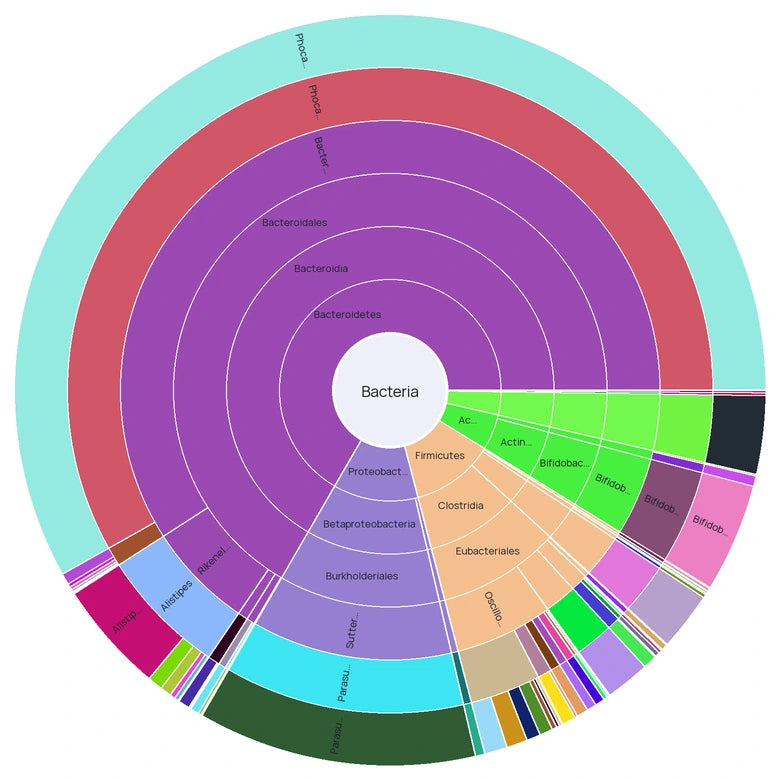
First test · living with IBS
One species holds 58.1% of the sample. Only 59 species are drawn across 36 genera — a community this concentrated has little to fall back on if its dominant organism is disturbed.
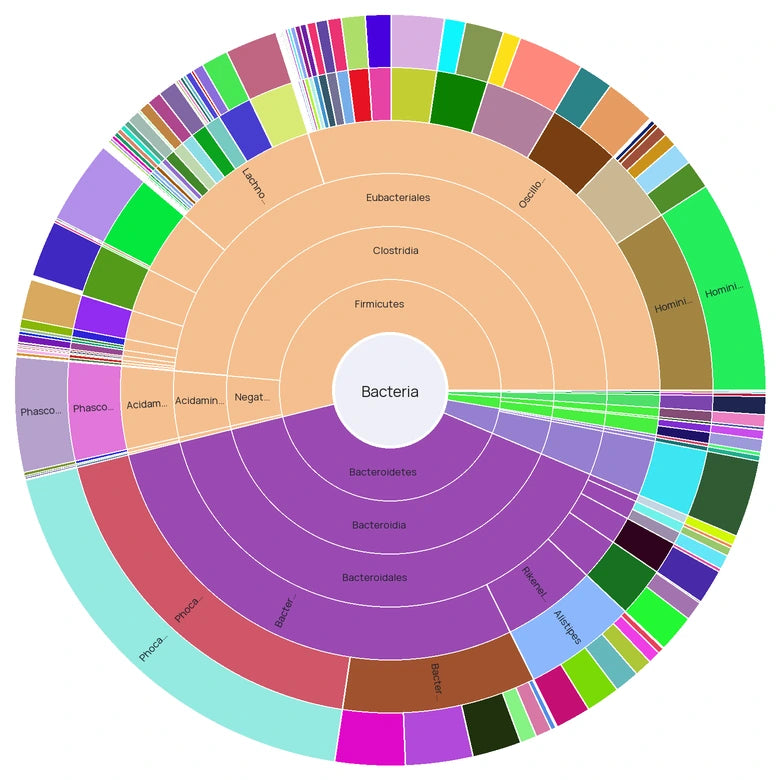
Third test · 14 weeks
The largest species is down to 18.8%. The plot now draws 137 species across 89 genera, and Firmicutes has overtaken Bacteroidetes. By this test the individual reported their IBS symptoms had resolved.
Peer-reviewed science
30+ peer-reviewed publications using the platform. Filter by clinical theme.
Read the research →Sign Up for Clinician Account →See and manage the whole ecosystem.
Sign up for a clinician account to order kits and manage patients, whether you stock GutID or refer. Wholesale pricing is available — book a call and we will take you through it, and set you up the same day.
Questions before you book? Send them over and we’ll answer them first.