


On this page
GI-MAP® and the GI Effects® Comprehensive Profile are both clinician-focused stool panels, but they are built on different methods. The GI-MAP, from Diagnostic Solutions Laboratory (DSL), uses quantitative PCR on a single stool sample, with H. pylori virulence and resistance genes on the standard panel. Genova Diagnostics' GI Effects combines PCR, culture with MALDI-TOF identification and sensitivity testing, microscopic ova and parasite exams and stool chemistry, from a one- or three-day collection.
Both panels profile commensal bacteria through named targets: nine plus two phyla on GI-MAP, 24 on GI Effects. GutID sees the entire bacterial ecosystem instead, reading about 2,500 bases of each bacterium's ribosomal DNA with Titan-1™ long-read sequencing, an approach backed by more than 30 peer-reviewed publications. GutID Pro adds 65 targeted markers, including H. pylori antigen, calprotectin and elastase-1, in the same kit and the same report.
This comparison is for clinicians choosing between the two panels or explaining the choice to patients. Details for both panels come from each lab's own pages and sample reports, plus dated ordering-platform listings for price, at time of writing (October 2026).
GI-MAP vs. GI Effects at a glance
| Attribute | GI-MAP® (DSL) | GI Effects® Comprehensive Profile (Genova) | GutID Pro |
|---|---|---|---|
| Who orders it | Practitioner order required; DSL doesn't accept orders from New York State | A practitioner; consumers can also buy it through Genova Connect, except in New York, New Jersey, Rhode Island and outside the continental US | Approved US clinicians, for patients 18 and over; not available in New York State |
| Core method | qPCR targeting the DNA of named organisms | 16S rRNA qPCR for commensals, culture with MALDI-TOF identification, microscopic O&P, real-time PCR for six protozoa, stool chemistry | Titan-1 long-read sequencing of the whole bacterial community, plus eight included lab panels run by a CLIA laboratory |
| Enteric organisms | 12 bacterial, 3 parasitic and 2 viral pathogen targets on the standard panel | Culture flags pathogenic and potentially pathogenic bacteria; Campylobacter, C. difficile and Shiga toxin E. coli are add-ons | GI panel with twelve enteric bacteria, including Salmonella and Campylobacter, and six enteric viruses; C. difficile toxin NAAT |
| H. pylori | Included, with eight virulence factor genes and antibiotic resistance genes | Stool antigen add-on | Stool antigen, included |
| Commensal bacteria | Nine targets plus Bacteroidetes, Firmicutes and their ratio | 24 targets mapped to seven phyla, with dysbiosis scores | Every bacterium in the sample to species, with relative abundance, plus 31 commensal and dysbiotic markers with reference ranges |
| Fungi and yeast | qPCR for five targets, including Candida spp. and C. albicans | Mycology culture with sensitivities; KOH preparation as an add-on | Six Candida species on the GI panel |
| Parasites | qPCR for 15 parasite targets, including seven protozoa and five worms | Microscopic O&P plus six PCR protozoa; macroscopic worm exam as an add-on | Six parasites on the GI panel |
| Digestion, inflammation and metabolites | Calprotectin, eosinophil activation protein, secretory IgA, anti-gliadin IgA, elastase-1, steatocrit, occult blood (FIT), β-glucuronidase | Pancreatic elastase-1, fecal fats and products of protein breakdown; calprotectin, eosinophil protein X, fecal secretory IgA and occult blood; short-chain fatty acids and beta-glucuronidase | Quantitative calprotectin, pancreatic elastase-1 and fecal occult blood; fecal leukocytes optional |
| Collection | One stool sample, shipped at room temperature | One-day or three-day collection, chosen by suspicion of parasites | One collection, two tubes |
| Results time | 7–10 business days, per DSL | Usually 7–17 days from receipt per the Genova Connect FAQ; some methods take up to 27 days | 3–4 weeks |
| Published price | Not published by DSL; Rupa Health listing showed $399 | Genova Connect: $474 plus a $15 physician fee; Rupa Health listing (one-day) showed $439 | Not published; clinicians sign in for pricing |
| Insurance | Out-of-network claims to most PPO plans; Traditional Medicare billed | Genova files claims, is in-network with select plans and accepts Medicare for medically necessary testing; direct consumer orders can't use insurance | Not published; ask GutID |
How GI-MAP works
DSL positions the GI-MAP as a comprehensive stool test built on quantitative PCR, with each assay aimed at the DNA of one organism or gene. Microbial results come back as quantities per gram of stool, against reference ranges. The panel is a fixed list: 17 pathogen targets; H. pylori with virulence genes plus clarithromycin, amoxicillin, fluoroquinolone and tetracycline resistance markers; nine commensal targets and two phyla; opportunistic bacteria, including the methane-producing Methanobacteriaceae; five fungal targets; cytomegalovirus and Epstein-Barr virus; seven protozoa and five worms. Intestinal health markers cover digestion, immune response and inflammation. Optional extras are zonulin, a stool gluten peptide test, a universal antibiotic-resistance gene panel and StoolOMX™ for bile acids and short-chain fatty acids.
How GI Effects works
Genova describes its approach as a "combination of PCR, culture, and microscopic testing methods." Commensal bacteria are measured by 16S rRNA qPCR: 24 targets mapped to seven phyla, scored with an Inflammation-Associated Dysbiosis score and a Methane Dysbiosis score. Culture grows bacteria and yeast, MALDI-TOF mass spectrometry names them, and recovered organisms can be tested for sensitivity to prescriptive and natural agents. Parasitology pairs microscopic ova and parasite examination with real-time PCR for six protozoa. Chemistry covers digestion, inflammation and immunology, and microbial metabolites, and the report rolls everything into Functional Imbalance Scores for maldigestion, inflammation, dysbiosis, metabolite imbalance and infection.
Add-ons include H. pylori stool antigen, Campylobacter, C. difficile, Shiga toxin E. coli, fecal lactoferrin, zonulin family peptide, a KOH preparation for yeast and a macroscopic exam for worms. Microbiomix, available alone or added to the Comprehensive Profile, uses shotgun metagenomic sequencing, which Genova says detects bacteria, fungi, protists and archaea.
Key differences
- Method. GI-MAP relies on qPCR for its microbial targets. GI Effects pairs qPCR for commensals and six protozoa with culture, microscopy and chemistry.
- Pathogens and H. pylori. GI-MAP's pathogen targets and H. pylori genes are on the standard panel. On GI Effects, culture reports pathogenic and potentially pathogenic organisms, while H. pylori, C. difficile, Campylobacter and Shiga toxin E. coli are add-ons.
- Yeast. GI-MAP detects fungal DNA for five targets. GI Effects grows yeast in culture and can report sensitivities to antifungal and natural agents.
- Parasites. GI-MAP uses qPCR for 15 parasite targets from one sample. GI Effects uses microscopy plus six PCR protozoa, and Genova calls a three-day collection optimal when suspicion of parasites is high.
- Commensals and metabolites. GI Effects reports 24 commensal targets with dysbiosis scores, plus short-chain fatty acids and products of protein breakdown, on the core panel. GI-MAP reports nine commensal targets and two phyla, with bile acids and short-chain fatty acids available through StoolOMX.
- Methanogens. GI-MAP reports Methanobacteriaceae; GI Effects reports Methanobrevibacter smithii and a Methane Dysbiosis score. Neither is a breath test.
- Ordering. GI-MAP needs a practitioner's order. GI Effects can also be bought directly through Genova Connect.
Comprehensive stool analysis vs. GI-MAP
"Comprehensive stool analysis" is a descriptive label rather than a single product. It is commonly used for multi-method panels that combine culture, microscopy and stool chemistry, which describes GI Effects. DSL also calls the GI-MAP a comprehensive stool test, but its design is different: a qPCR panel for named organisms, with chemistry markers alongside. For how another lab's stool testing lines up, see our Doctor's Data stool test vs. GI-MAP comparison.
When GI-MAP is the right choice
- You want quantitative, DNA-based results for a fixed list of pathogens, parasites, fungi and opportunistic bacteria from a single collection.
- You want H. pylori virulence and resistance genes on the standard report.
- The patient would struggle with a multi-day protocol, or DSL's claims to PPO plans and Traditional Medicare matter.
Our guides cover what a GI-MAP tests for and what a GI-MAP costs.
When GI Effects is the right choice
- You want organisms grown in culture, with sensitivity results for prescriptive and natural agents.
- You want microscopy-based parasitology, with the option of a three-day collection.
- You want digestion and short-chain fatty acid chemistry on the core report, condensed into scored summary pages.
- The patient wants to buy directly through Genova Connect, available in most of the continental US.
With either panel, anyone who has a suspected acute infection or red-flag symptoms (blood in the stool, unexplained weight loss, fever, or severe or persistent diarrhea) should see a clinician for diagnostic testing.
When GutID Pro is the better choice
- The whole community matters. Rather than nine or 24 commensal targets, Titan-1 identifies and measures every bacterium in the sample to species, with diversity, balance and relative abundance.
- You want H. pylori and C. difficile included. H. pylori stool antigen and C. difficile toxin NAAT come with every kit, along with enteric bacteria such as Campylobacter, enteric viruses, parasites and Candida species.
- Stool markers belong in the same report. Quantitative calprotectin, pancreatic elastase-1 and fecal occult blood are included, with 31 commensal and dysbiotic markers that each carry a reference range.
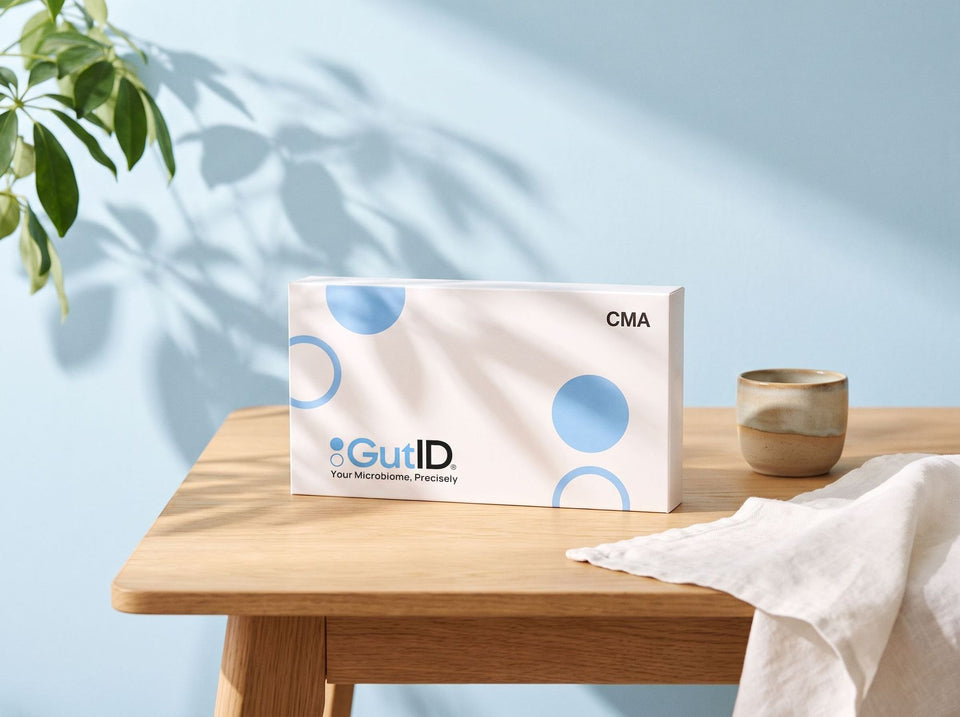
Every Pro kit is the Complete Microbiome Assessment, adding gut-brain, gut-immune, gut-metabolism and gut-heart axes, and everything returns in one report. Approved US clinicians order and interpret it for patients 18 and over, outside New York State; request a clinician account.
Why GutID sees more
Targeted assays answer the questions they were built for. GI-MAP's qPCR assays and the 24 commensal targets on GI Effects are chosen in advance, and a targeted assay reports only the organisms it was designed to find. Titan-1 has no target list: it reads the bacterial community in the sample and sees the entire ecosystem, from diversity and balance to each species' relative abundance and how the mix changes between tests.
Read length makes this possible. Titan-1 reads one continuous ~2,500-base fragment from a patented amplicon spanning the full 16S gene, the ITS and the start of 23S, roughly 5–10 times what a short-read 16S test reads. Its classifier works from that whole read, not short markers matched to a fixed database, so it identifies organisms a fixed panel can't and quantifies them even when no species name exists.
More than 30 peer-reviewed papers use the approach, in journals including PLOS ONE, Frontiers in Microbiology and Microbial Genomics; see how Titan-1 works and the published evidence. In a 2022 Microbial Genomics study, Gehrig and colleagues found that long-read profiling of the 16S-ITS-23S amplicon, unlike widely used short-read 16S profiling, gave strain-level community resolution and insight into novel taxa.
Titan-1 samples are processed by a CLIA laboratory in the United States; for GutID Pro, a CLIA laboratory runs the 65 targeted markers on a second tube, returned in one report with the full ecosystem. See the GutID sample report.
Frequently asked questions
What is the difference between GI-MAP and GI Effects?
Method and scope. GI-MAP is a qPCR panel run on one stool sample, with H. pylori genes included. GI Effects combines qPCR, culture with sensitivities, microscopy and chemistry, from a one- or three-day collection, with H. pylori as an add-on.
Can patients order GI-MAP or GI Effects without a practitioner?
GI-MAP requires a practitioner's order. At time of writing, GI Effects can be bought through Genova Connect for $474 plus a $15 physician fee, with independent physician oversight, within the continental US except New York, New Jersey and Rhode Island. Insurance can't be used for those direct orders, though Genova lists them as HSA/FSA eligible.
How much do GI-MAP and GI Effects cost?
DSL doesn't publish a GI-MAP self-pay price, and Rupa Health's listing showed $399 at time of writing. Genova Connect lists GI Effects (#2200) at $474 plus a $15 physician fee, and Rupa Health's one-day listing showed $439. What a patient pays also depends on insurance and practitioner fees.
Is GutID better than GI-MAP or GI Effects?
For seeing the entire bacterial ecosystem, yes, because it reads the community rather than a list of targets. Titan-1 reads 5–10 times more of each bacterium's ribosomal DNA than a short-read 16S test, identifies organisms a fixed panel can't, and rests on more than 30 peer-reviewed publications. GutID Pro then puts that ecosystem and 65 targeted markers in one kit. See also GutID vs. Genova GI Effects.
What does GutID Pro add?
Start with the Complete Microbiome Assessment, then add eight lab panels run by a CLIA laboratory on a second tube from the same collection. Thirty-one commensal and dysbiotic markers each get a reference range; the stool markers are quantitative calprotectin, pancreatic elastase-1 and fecal occult blood; H. pylori stool antigen is reported as detected or not detected; and a 30-marker GI panel covers enteric bacteria, enteric viruses, parasites and Candida species, with C. difficile toxin NAAT. That is 65 markers in the same report as the ecosystem. Patients can't order Pro themselves but can ask their clinician.
Sources
- GI-MAP® (GI Microbial Assay Plus) — Diagnostic Solutions Laboratory (accessed October 30, 2026)
- GI-MAP sample report (PDF) — Diagnostic Solutions Laboratory (accessed October 30, 2026)
- GI-MAP Interpretive Guide, 2025 edition (PDF) — Diagnostic Solutions Laboratory (accessed October 30, 2026)
- Patient Billing Policies — Diagnostic Solutions Laboratory (accessed October 30, 2026)
- GI Effects® Stool Profiles — Genova Diagnostics (accessed October 30, 2026)
- GI Effects® Comprehensive Profile – Stool — Genova Diagnostics (accessed October 30, 2026)
- GI Effects Comprehensive Profile (#2200) sample report (PDF) — Genova Diagnostics (accessed October 30, 2026)
- Gut health testing — Genova Connect (accessed October 30, 2026)
- Billing Options — Genova Diagnostics (accessed October 30, 2026)
- Microbiomix — Genova Diagnostics (accessed October 30, 2026)
- Diagnostic Solutions GI-MAP — Rupa Health (accessed October 30, 2026)
- Genova GI Effects Comprehensive Profile – 1 Day — Rupa Health (accessed October 30, 2026)
- Finding the right fit: evaluation of short-read and long-read sequencing approaches to maximize the utility of clinical microbiome data (Gehrig et al., 2022) — Microbial Genomics (accessed October 30, 2026)
GutID provides wellness and educational insights and is not a diagnostic test. GI-MAP®, StoolOMX™, GI Effects® and Microbiomix are trademarks of their respective owners. GutID is not affiliated with Diagnostic Solutions Laboratory, Genova Diagnostics or Rupa Health.
This article is for education and is not medical advice. GutID provides wellness and educational insights and is not a diagnostic test.
