
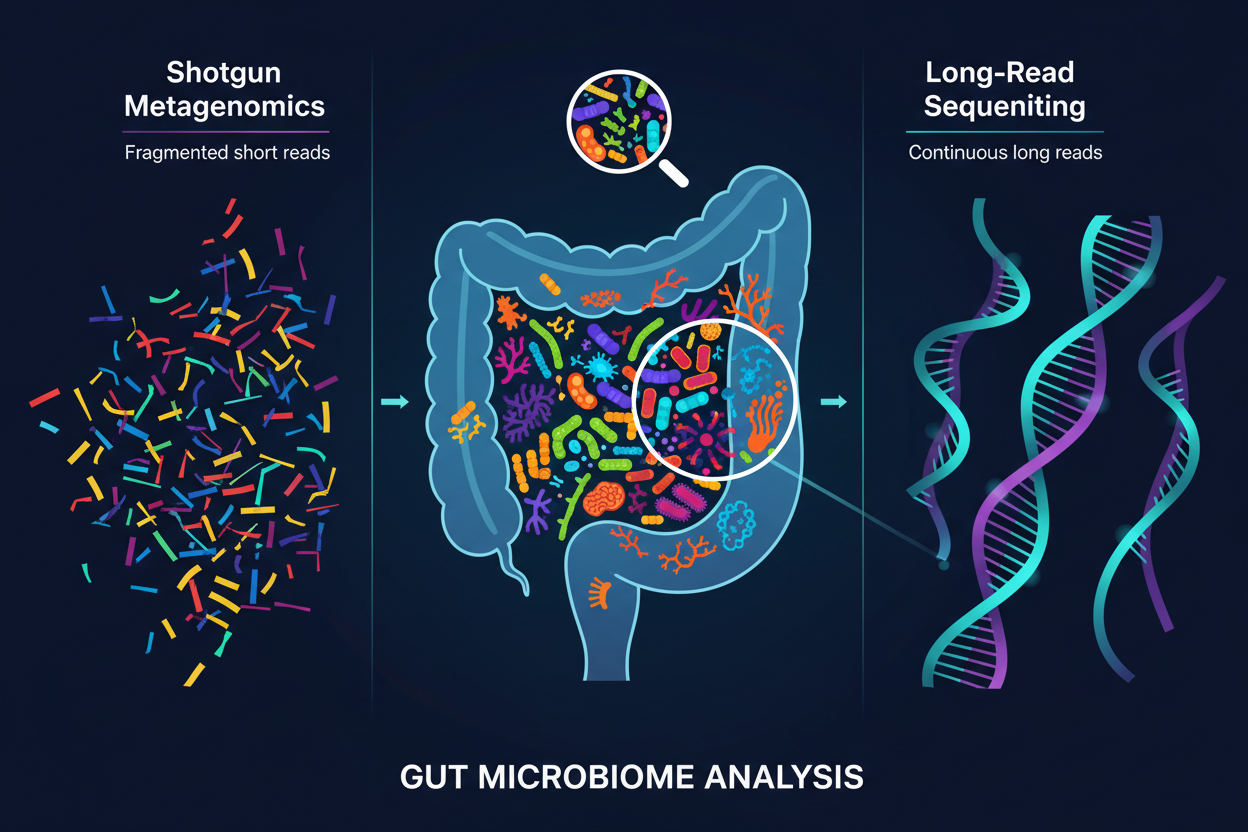

For years, shotgun metagenomic sequencing has been considered the gold standard for microbiome analysis. It represented a significant advancement over traditional 16S sequencing by attempting to measure everything within a stool sample—not just bacteria, but fungi, viruses, archaea, parasites, and human DNA.
But as microbiome research has evolved, an important question has emerged:
Does sequencing more DNA actually produce a more accurate picture of the bacterial ecosystem?
Increasingly, the answer appears to be not necessarily.
Today, advances in long-read sequencing technologies are changing how clinicians think about microbiome testing. Rather than generating more DNA fragments, these technologies focus on generating more complete bacterial measurements, providing a clearer picture of the ecosystem that ultimately drives clinical interpretation.
Why Measurement Matters
Every microbiome report begins with two fundamental questions:
How many different bacterial species are present? (Diversity)
How much of each bacterial species is there? (Relative abundance)
These two measurements underpin nearly every clinical interpretation—from ecosystem resilience and dysbiosis to enterotype classification and therapeutic response.
But diversity and relative abundance are only as accurate as the underlying bacterial measurements.
If bacterial species are missed, every downstream calculation changes.
The microbiome itself hasn't changed.
Only the measurement has.
Imagine Measuring a Forest
Imagine you're surveying a forest.
Your goal isn't simply to identify an oak tree.
Your goal is to understand the entire ecosystem.
How many different tree species exist?
Which species dominate the landscape?
Which are rare?
Is the ecosystem balanced?
Now imagine failing to count one of the forest's most common tree species.
Suddenly every remaining tree appears more abundant than it actually is.
The forest hasn't changed.
Only your map of the forest has.
The gut microbiome works exactly the same way.
Every bacterial species contributes to our understanding of the ecosystem. Missing even one abundant organism changes the relative abundance of every other organism, potentially leading to different clinical conclusions.
How Shotgun Metagenomics Builds the Map
Shotgun sequencing approaches this challenge by randomly fragmenting all of the DNA within a stool sample.
Millions of small DNA fragments are generated from bacteria, fungi, viruses, archaea, human cells, and dietary material.
Those fragments must then be computationally reconstructed by comparing them against large reference databases of previously characterized genomes.
Imagine shredding thousands of books into tiny pieces and trying to determine which books were originally present by matching those fragments to a library.
If enough fragments are recovered—and the book already exists in the library—you can often identify it.
If the book isn't in the library, or too few fragments are collected, identification becomes much more difficult.
The same principle applies to shotgun sequencing.
Because bacterial genomes are reconstructed from fragmented DNA, successful identification depends on several factors:
- Sequencing depth
- Computational assembly
- Reference database completeness
- Genome complexity
Low-abundance organisms may not be sequenced deeply enough to reconstruct.
Closely related organisms may be difficult to distinguish.
Previously uncharacterized bacteria may never be confidently identified.
The result is an ecosystem map that can appear less diverse—or differently balanced—than the biological reality.
How Long-Read Sequencing Takes a Different Approach
Long-read ribosomal sequencing starts with a different question.
Rather than asking,
"Can we reconstruct this bacterium from fragments?"
It asks,
"Can we directly measure each bacterium using its own unique genetic fingerprint?"
Titan-1™ captures one long, continuous ribosomal DNA sequence spanning the 16S rRNA gene, Internal Transcribed Spacer (ITS), and 23S rRNA gene in a single read.
Every bacterial species carries a unique ribosomal fingerprint.
Because the entire fingerprint is sequenced continuously:
- No DNA fragments need to be reassembled.
- No genome reconstruction is required.
- The bacterial ecosystem can be measured directly before taxonomic annotation.
This creates a fundamentally different workflow than shotgun sequencing.
Why Continuous Reads Matter
Returning to our forest analogy, imagine every tree carries a unique barcode.
Instead of collecting thousands of broken barcode fragments and trying to reconstruct which trees are present, you simply scan each complete barcode.
Every tree can be counted directly.
Even if you've never seen that tree species before.
Similarly, Titan-1 measures complete bacterial fingerprints rather than reconstructing genomes from fragments.
Whether a bacterial species has been extensively studied or represents a previously uncharacterized organism, its genetic fingerprint still contributes to mapping the ecosystem.
The result is a more complete representation of bacterial diversity and relative abundance.
Why This Matters Clinically
Most clinicians aren't ordering microbiome tests simply to generate species lists.
They're trying to answer questions such as:
- Why is this patient experiencing persistent dysbiosis?
- Has the ecosystem become more resilient after treatment?
- Is diversity improving?
- Which bacterial communities are expanding or disappearing over time?
Those answers depend on accurate ecosystem measurement.
If important bacterial species are underrepresented or absent, the relative abundance of every remaining organism shifts.
That changes:
- Diversity calculations
- Relative abundance measurements
- Enterotype assignment
- Community structure
- Longitudinal comparisons
- Clinical interpretation
In other words, the quality of every downstream insight depends on the quality of the original measurement.
Shotgun vs. Titan-1 at a Glance
| Feature | Shotgun Metagenomics | Titan-1™ Long-Read Sequencing |
|---|---|---|
| Sequencing approach | Millions of short DNA fragments | One continuous bacterial ribosomal read |
| Assembly required | Yes | No |
| Genome reconstruction | Required | Not required |
| Measures bacterial fingerprint directly | No | Yes |
| Dependence on reference databases for reconstruction | Yes | No (for initial ecosystem measurement) |
| Bacterial taxonomic resolution | High, dependent on assembly and database coverage | High species- and strain-level resolution using continuous ribosomal sequences |
| Primary strength | Broad detection across multiple kingdoms | Highly accurate characterization of the bacterial ecosystem |
Choosing the Right Technology
Shotgun metagenomics remains a powerful research tool, particularly when investigating viruses, fungi, antimicrobial resistance genes, or broader metagenomic functions.
However, if the primary clinical question is:
"What does my patient's bacterial ecosystem actually look like?"
Then, measurement accuracy becomes the priority.
Long-read ribosomal sequencing was designed specifically to improve that measurement.
By capturing complete bacterial genetic fingerprints rather than reconstructing fragmented genomes, Titan-1 provides clinicians with a more complete map of the bacterial ecosystem—the foundation upon which every diversity metric, relative abundance calculation, and clinical interpretation depends.
At GutID, we believe better clinical decisions begin with better measurements. Titan-1™ was developed to provide clinicians with a more accurate representation of the bacterial ecosystem, enabling greater confidence in microbiome interpretation and patient care.
Share:
GutID® vs. GI-MAP: Is the Practitioner Standard Still Accurate?
GutID® vs. Thorne Gut Health Test: Which Provides the Most Accurate Picture of the Gut Microbiome?