

If you're comparing GutID® and the Thorne Gut Health Test, you're already looking at two of the most advanced microbiome technologies available today.
Both tests use next-generation DNA sequencing, but they were designed to answer fundamentally different questions.
Thorne uses shotgun metagenomic sequencing, a technology developed to broadly sequence all of the DNA present in a stool sample.
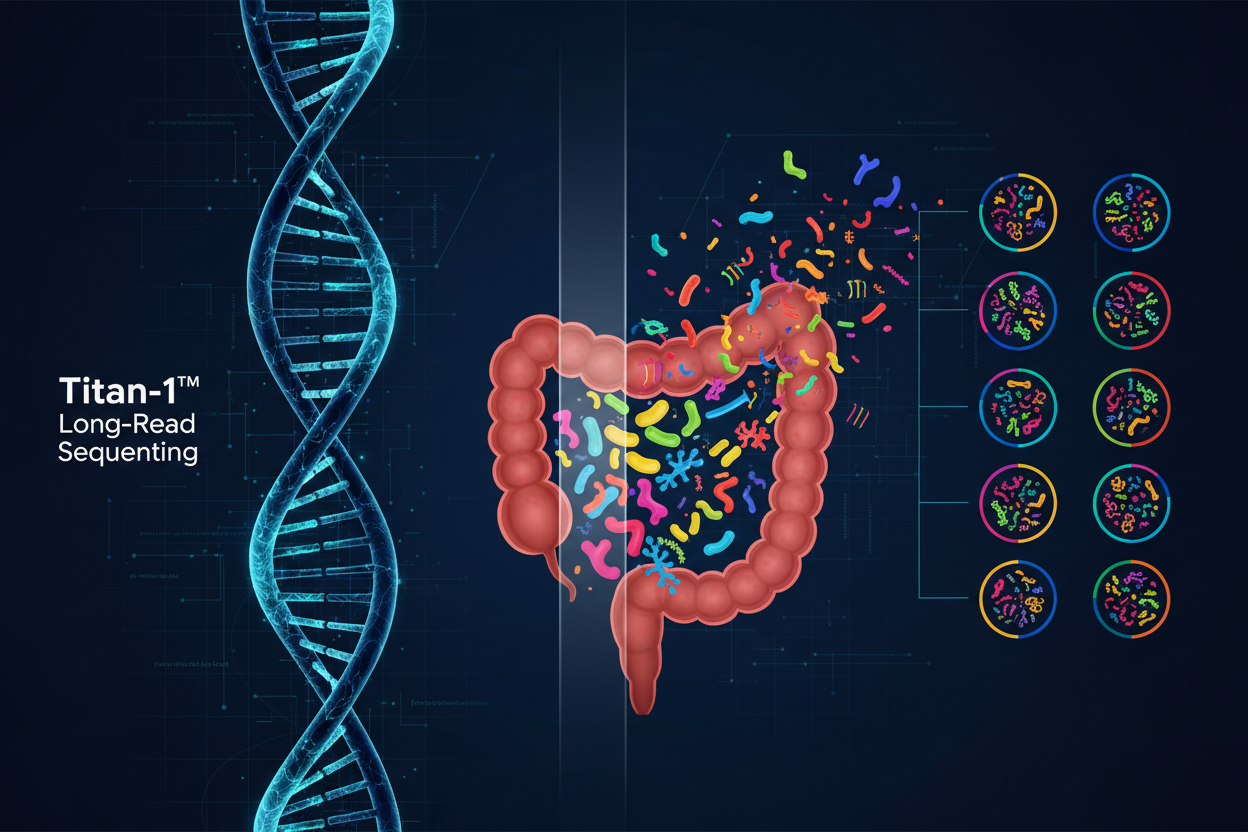
GutID uses Titan-1™ long-read ribosomal sequencing, a technology developed specifically to create the most complete and accurate map of the bacterial ecosystem.
That distinction matters because every microbiome interpretation begins with one simple question:
How accurately can we measure the bacterial ecosystem?
Why the Bacterial Ecosystem Matters
The human gut is one of the most complex ecosystems on Earth.
Like any ecosystem, its health depends on balance.
Clinicians aren't simply looking for the presence or absence of one bacterium.
They're trying to understand:
- How many bacterial species are present?
- Which organisms dominate the ecosystem?
- Which organisms are rare?
- Is the ecosystem resilient or disrupted?
- Has dysbiosis developed?
These questions are answered using measurements like diversity and relative abundance.
But those measurements are only as accurate as the ecosystem that was measured in the first place.
Think of the Microbiome as a Forest
Imagine you're mapping a forest.
Your goal isn't to identify one oak tree.
Your goal is to understand the entire forest.
How many tree species are present?
Which trees dominate?
Which are rare?
Is the ecosystem balanced?
Now imagine accidentally missing one of the forest's largest tree populations.
The forest hasn't changed.
But your map has.
Every remaining tree now appears more abundant than it actually is.
Your understanding of the ecosystem changes—even though the ecosystem itself is exactly the same.
The gut microbiome works the same way.
Missing bacterial species changes the calculated abundance of every other organism in the sample.
That changes the interpretation.
How Thorne Measures the Microbiome
Thorne uses shotgun metagenomic sequencing.
Shotgun sequencing randomly fragments all of the DNA within a stool sample into millions of small pieces.
Those fragments are then computationally reconstructed by comparing them against large reference databases of previously characterized genomes.
This approach provides broad genomic information, but reconstructing a complete bacterial ecosystem from fragmented DNA presents important challenges.
Some bacterial genomes may not be reconstructed completely.
Rare organisms may not be sequenced deeply enough to appear in the final results.
Previously uncharacterized bacteria may not be represented in current databases.
As a result, portions of the bacterial ecosystem may be underrepresented or absent from the final ecosystem map.
For clinicians, this matters because relative abundance is calculated using only the organisms that were measured.
If important members of the ecosystem are missing, every downstream measurement changes.
Why GutID Built Titan-1™
Titan-1 was developed around a different philosophy.
Instead of reconstructing bacteria from millions of DNA fragments, Titan-1 directly measures each bacterium using its own unique genetic fingerprint.
Each fingerprint is captured as one long, continuous ribosomal DNA sequence spanning the 16S rRNA gene, Internal Transcribed Spacer (ITS), and 23S rRNA gene.
Because the fingerprint is read continuously:
- There are no fragmented bacterial sequences to reconstruct.
- No genome assembly is required.
- The bacterial ecosystem is measured directly before organisms are annotated.
Perhaps most importantly, measurement is not dependent on whether a bacterium already exists in today's reference databases.
Whether a bacterial species has been extensively studied or has never been characterized before, its genetic fingerprint still contributes to mapping the ecosystem.
That means more bacteria can be measured.
And a more complete ecosystem can be mapped.
Why Complete Ecosystem Mapping Matters
Every microbiome report depends on accurately measuring the bacterial ecosystem.
When bacterial species are missed:
- Relative abundance changes.
- Diversity calculations change.
- Ecosystem balance changes.
- Clinical interpretation changes.
The microbiome hasn't changed.
Only the measurement has.
Titan-1 was engineered to reduce this problem by directly measuring complete bacterial genetic fingerprints rather than reconstructing fragmented DNA.
The result is a more complete map of the bacterial ecosystem and greater confidence in the measurements that clinicians use to guide patient care.
GutID vs. Thorne: Key Differences
| Feature | GutID® | Thorne Gut Health Test |
|---|---|---|
| Technology | Titan-1™ Long-Read Ribosomal Sequencing | Shotgun Metagenomic Sequencing |
| Primary Goal | Complete bacterial ecosystem characterization | Broad metagenomic sequencing |
| Reads | One continuous ~2,500 bp bacterial ribosomal sequence | Millions of short DNA fragments |
| DNA Reconstruction | Not required | Required |
| Measures bacterial genetic fingerprints directly | Yes | No |
| Dependence on reference databases to reconstruct bacteria | No | Yes |
| Focus | Accurate bacterial ecosystem mapping | Broad genomic analysis |
Which Test Is Better for Understanding the Bacterial Microbiome?
If your goal is to broadly survey all DNA present in a stool sample—including bacterial, viral, fungal, host, and other genetic material—shotgun metagenomics provides a wide-ranging view of the sample.
However, if your clinical objective is to understand the bacterial ecosystem—the community that underpins diversity, relative abundance, dysbiosis, and many microbiome-based clinical decisions—the quality of your interpretation depends on the quality of your ecosystem measurement.
This is where GutID was designed to be different.
Rather than reconstructing the bacterial community from millions of fragmented DNA sequences, Titan-1 directly measures complete bacterial genetic fingerprints to build a more complete map of the ecosystem. By reducing dependence on DNA reconstruction and reference database coverage during measurement, GutID is designed to capture a more accurate representation of the bacterial community—including organisms that may be rare or not yet fully characterized.
For clinicians, that means greater confidence that the ecosystem being interpreted is as complete and representative as possible. Because the more accurately the bacterial ecosystem is measured, the more confidently diversity, relative abundance, and dysbiosis can be assessed—and the more informed clinical decisions become.
The Bottom Line
Microbiome testing is ultimately about understanding an ecosystem.
The clearer and more complete that ecosystem map is, the more confidence clinicians can have in the conclusions they draw from it.
While shotgun metagenomics reconstructs the bacterial community from fragmented DNA, GutID's patented Titan-1™ technology was purpose-built to directly measure complete bacterial genetic fingerprints and generate the most complete bacterial ecosystem map possible.
Because better ecosystem measurement doesn't just produce better data—it provides the foundation for better microbiome interpretation and more confident clinical care.
Share:
Shotgun Metagenomics vs. Long-Read Sequencing: Which Technology Provides the Most Accurate View of the Gut Microbiome?
How to Offer Microbiome Testing in Your Clinic: A Practical Guide for Clinicians